Flutter RUM with Flutterific OpenTelemetry
Full Real User Monitoring (RUM) for Flutter apps using OpenTelemetry. Traces and metrics are exported to any OTLP-compatible collector endpoint. Attribute names follow OTel semantic conventions.
Add flutterrific_opentelemetry, create a lib/otel/ directory with the files
below, wrap your main.dart, and you get automatic session, device, navigation,
cold start, jank, ANR, breadcrumbs, battery-aware sampling, W3C trace
propagation, and flush-on-background telemetry on every span.
If you prefer lower-level control with the opentelemetry Dart SDK, see the
Flutter OpenTelemetry guide.
Storing and querying these sessions at production volume is what base14 Scout does. Check out Scout RUM.
Architecture
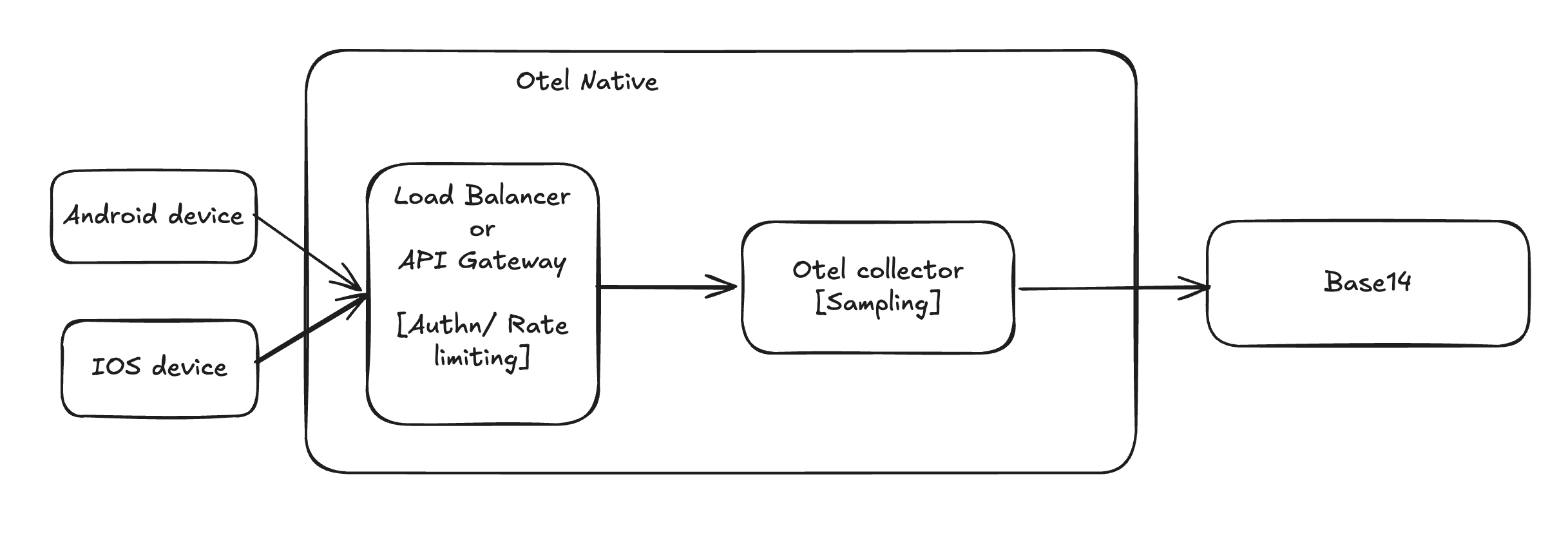
Mobile devices send OTLP telemetry through a load balancer / API gateway (with authentication and rate limiting) to an OTel collector (with server-side sampling), which forwards to Scout.
What You Get
| Signal | Span / Metric | Automatic? |
|---|---|---|
| Session | session.id, session.start, session.duration_ms on every span | Yes |
| Device | device.model.identifier, device.model.name, device.manufacturer, device.id | Yes |
| Battery | device.battery.level, device.battery.state on every span | Yes |
| App | service.version, app.build_id, app.installation.id, service.name | Yes |
| Network | network.type (wifi / cellular / ethernet / none) - live updates | Yes |
| Current Screen | app.screen.name on every span | Yes |
| Cold Start | app.cold_start span + app.cold_start_ms histogram | Yes |
| Screen Load | screen.load span + screen.load_time_ms histogram | Yes |
| Screen Dwell | screen.dwell span + screen.dwell_time_ms histogram | Yes |
| Navigation | navigation.push / pop / replace / remove spans | Yes |
| Breadcrumbs | Last 20 user actions attached to error spans as error.breadcrumbs | Yes |
| App Lifecycle | app_lifecycle.changed spans (active, inactive, paused, etc.) | Yes |
| Jank / ANR | jank.frame spans + anr.detected spans + counters + histograms | Yes |
| Flutter Errors | Error spans with screen context, session ID, and breadcrumbs | Yes |
| Flush on Background | Pending spans flushed when app enters background | Yes |
| Battery-Aware Sampling | Reduces telemetry when battery is low (50% at 10–20%, 20% below 10%) | Yes |
| W3C Trace Context | traceparent header injected on all HTTP requests | Yes |
| Error Boundary | Catches render-time errors with retry UI + error_boundary.caught span | Manual |
| User Identity | enduser.id, enduser.email, enduser.role on all spans (when set) | Manual |
| Button Clicks | interaction.*.click spans | Manual |
| List Selections | interaction.*.list_selection spans | Manual |
| Rage Clicks | rage_click.detected spans + rage_click.count counter | Manual |
| Custom Events | custom_event.* spans | Manual |
| HTTP Requests | http.* spans with URL, status code, size, traceparent | Manual |
Add Dependencies
dependencies:
  flutterrific_opentelemetry: ^0.3.2
  device_info_plus: ^11.0.0
  package_info_plus: ^8.0.0
  connectivity_plus: ^6.0.0
  battery_plus: ^6.0.0
flutter pub get
Create the lib/otel/ Directory
All instrumentation code lives in lib/otel/. Create these files:
rum_session.dart - Central RUM State
Singleton that holds session, user, device, app, screen, network, battery, and
breadcrumb context. Every span gets a snapshot of this state via
getCommonAttributes().
Attribute names follow OTel semantic conventions:
import 'dart:async';
import 'dart:convert';
import 'dart:io';
import 'dart:math';
import 'package:battery_plus/battery_plus.dart';
import 'package:connectivity_plus/connectivity_plus.dart';
import 'package:device_info_plus/device_info_plus.dart';
import 'package:flutterrific_opentelemetry/flutterrific_opentelemetry.dart';
import 'package:package_info_plus/package_info_plus.dart';

class RumSession {
  RumSession._();
  static final RumSession instance = RumSession._();

  // --- Session (semconv: session.*) ---
  String sessionId = 'pending';
  DateTime sessionStart = DateTime.now();

  // --- User ---
  String? _userId;
  String? _userEmail;
  String? _userRole;

  // --- Current Screen (semconv: app.screen.*) ---
  String _currentScreen = '/';
  DateTime _screenEnteredAt = DateTime.now();

  // --- Device (semconv: device.*) ---
  String _deviceModelIdentifier = 'unknown';
  String _deviceModelName = 'unknown';
  String _deviceManufacturer = 'unknown';
  String _deviceId = 'unknown';

  // --- App (semconv: app.*, service.*) ---
  String _appVersion = 'unknown';
  String _appBuildId = 'unknown';
  String _appPackageName = 'unknown';
  String _appInstallationId = 'unknown';

  // --- Network ---
  String _networkType = 'unknown';
  StreamSubscription<List<ConnectivityResult>>? _connectivitySub;

  // --- Cold Start ---
  Duration? coldStartDuration;

  // --- Breadcrumbs ---
  static const int _maxBreadcrumbs = 20;
  final List<Map<String, String>> _breadcrumbs = [];

  // --- Battery ---
  final Battery _battery = Battery();
  int _batteryLevel = 100;
  String _batteryState = 'unknown';
  StreamSubscription<BatteryState>? _batterySub;
  bool _forceSample = false;
  final Random _random = Random();

  Future<void> initialize() async {
    sessionId = DateTime.now().microsecondsSinceEpoch.toRadixString(36);
    sessionStart = DateTime.now();
    await _loadDeviceInfo();
    await _loadPackageInfo();
    await _initConnectivity();
    await _initBattery();
  }

  // --- User identification API ---

  void setUser({String? id, String? email, String? role}) {
    _userId = id;
    _userEmail = email;
    _userRole = role;
  }

  void clearUser() {
    _userId = null;
    _userEmail = null;
    _userRole = null;
  }

  // --- Screen tracking ---

  void setCurrentScreen(String screen) {
    _currentScreen = screen;
    _screenEnteredAt = DateTime.now();
  }

  String get currentScreen => _currentScreen;

  Duration get currentScreenDwellTime =>
      DateTime.now().difference(_screenEnteredAt);

  // --- Breadcrumb API ---

  /// Records a breadcrumb. Keeps the last [_maxBreadcrumbs] entries (FIFO).
  void recordBreadcrumb(String type, String label,
      [Map<String, String>? data]) {
    final crumb = <String, String>{
      'ts': DateTime.now().toIso8601String(),
      'type': type,
      'label': label,
    };
    if (data != null) crumb.addAll(data);

    _breadcrumbs.add(crumb);
    if (_breadcrumbs.length > _maxBreadcrumbs) {
      _breadcrumbs.removeAt(0);
    }
  }

  /// Returns JSON-encoded breadcrumb list for attaching to error spans.
  String getBreadcrumbString() => jsonEncode(_breadcrumbs);

  // --- Battery-aware sampling ---

  /// Returns true if this span should be sampled based on battery level.
  /// Error spans should call [forceNextSample] beforehand to guarantee capture.
  bool shouldSample() {
    if (_forceSample) {
      _forceSample = false;
      return true;
    }
    if (_batteryState == 'charging' || _batteryLevel > 20) {
      return true; // 100% sampling
    }
    if (_batteryLevel > 10) {
      return _random.nextDouble() < 0.5; // 50% sampling
    }
    return _random.nextDouble() < 0.2; // 20% sampling
  }

  /// Ensures the next call to [shouldSample] returns true.
  void forceNextSample() => _forceSample = true;

  /// Refreshes battery level on demand (e.g. when app resumes).
  Future<void> refreshBatteryState() async {
    _batteryLevel = await _battery.batteryLevel;
  }

  // --- Common attributes for every span (OTel semconv) ---

  Attributes getCommonAttributes() {
    final map = <String, Object>{
      // Session - semconv: session.*
      'session.id': sessionId,
      'session.start': sessionStart.toIso8601String(),
      'session.duration_ms':
          DateTime.now().difference(sessionStart).inMilliseconds,

      // Current screen - semconv: app.screen.*
      'app.screen.name': _currentScreen,

      // Device - semconv: device.*
      'device.model.identifier': _deviceModelIdentifier,
      'device.model.name': _deviceModelName,
      'device.manufacturer': _deviceManufacturer,
      'device.id': _deviceId,
      'os.type': Platform.operatingSystem,
      'os.version': Platform.operatingSystemVersion,

      // App - semconv: app.*, service.*
      'service.version': _appVersion,
      'app.build_id': _appBuildId,
      'app.installation.id': _appInstallationId,
      'service.name': _appPackageName,

      // Network
      'network.type': _networkType,

      // Battery
      'device.battery.level': _batteryLevel,
      'device.battery.state': _batteryState,
    };

    if (_userId != null) map['enduser.id'] = _userId!;
    if (_userEmail != null) map['enduser.email'] = _userEmail!;
    if (_userRole != null) map['enduser.role'] = _userRole!;

    if (coldStartDuration != null) {
      map['app.cold_start_ms'] = coldStartDuration!.inMilliseconds;
    }

    return map.toAttributes();
  }

  Future<void> _loadDeviceInfo() async {
    final deviceInfo = DeviceInfoPlugin();
    if (Platform.isAndroid) {
      final android = await deviceInfo.androidInfo;
      _deviceModelIdentifier = android.model;
      _deviceModelName = android.model;
      _deviceManufacturer = android.manufacturer;
      _deviceId = android.id;
      _appInstallationId = android.id;
    } else if (Platform.isIOS) {
      final ios = await deviceInfo.iosInfo;
      _deviceModelIdentifier = ios.utsname.machine;
      _deviceModelName = ios.name;
      _deviceManufacturer = 'Apple';
      _deviceId = ios.identifierForVendor ?? 'unknown';
      _appInstallationId = ios.identifierForVendor ?? 'unknown';
    }
  }

  Future<void> _loadPackageInfo() async {
    final info = await PackageInfo.fromPlatform();
    _appVersion = info.version;
    _appBuildId = info.buildNumber;
    _appPackageName = info.packageName;
  }

  Future<void> _initConnectivity() async {
    final connectivity = Connectivity();
    final results = await connectivity.checkConnectivity();
    _updateNetworkType(results);
    _connectivitySub =
        connectivity.onConnectivityChanged.listen(_updateNetworkType);
  }

  void _updateNetworkType(List<ConnectivityResult> results) {
    if (results.contains(ConnectivityResult.wifi)) {
      _networkType = 'wifi';
    } else if (results.contains(ConnectivityResult.mobile)) {
      _networkType = 'cellular';
    } else if (results.contains(ConnectivityResult.ethernet)) {
      _networkType = 'ethernet';
    } else if (results.contains(ConnectivityResult.none)) {
      _networkType = 'none';
    } else {
      _networkType = 'other';
    }
  }

  Future<void> _initBattery() async {
    try {
      _batteryLevel = await _battery.batteryLevel;
      final state = await _battery.batteryState;
      _updateBatteryState(state);
      _batterySub =
          _battery.onBatteryStateChanged.listen(_updateBatteryState);
    } catch (_) {
      // Battery info unavailable (e.g. emulator) - keep defaults.
    }
  }

  void _updateBatteryState(BatteryState state) {
    switch (state) {
      case BatteryState.charging:
        _batteryState = 'charging';
      case BatteryState.discharging:
        _batteryState = 'discharging';
      case BatteryState.full:
        _batteryState = 'full';
      case BatteryState.connectedNotCharging:
        _batteryState = 'connected_not_charging';
      case BatteryState.unknown:
        _batteryState = 'unknown';
    }
  }

  void dispose() {
    _connectivitySub?.cancel();
    _batterySub?.cancel();
  }
}
rum_span_processor.dart - Span Enrichment + Battery-Aware Sampling
Wraps the real BatchSpanProcessor and injects RUM context into every span
at onStart. Also implements battery-aware sampling: when battery is low,
non-error spans may be dropped to conserve power.
| Battery State | Sampling Rate |
|---|---|
| Charging or above 20% | 100% |
| 10–20% | 50% |
| Below 10% | 20% |
| Error spans | Always 100% (use forceNextSample()) |
// ignore: depend_on_referenced_packages
import 'package:dartastic_opentelemetry/dartastic_opentelemetry.dart' as sdk;
// ignore: depend_on_referenced_packages
import 'package:dartastic_opentelemetry_api/dartastic_opentelemetry_api.dart';
import 'rum_session.dart';
class RumSpanProcessor implements sdk.SpanProcessor {
RumSpanProcessor(this._delegate);
final sdk.SpanProcessor _delegate;
final Set<int> _droppedSpans = {};
Future<void> onStart(sdk.Span span, Context? parentContext) async {
// Battery-aware sampling - drop non-essential spans when battery is low.
if (!RumSession.instance.shouldSample()) {
_droppedSpans.add(span.hashCode);
return;
}
final rumAttributes = RumSession.instance.getCommonAttributes();
span.addAttributes(rumAttributes);
return _delegate.onStart(span, parentContext);
}
Future<void> onEnd(sdk.Span span) {
if (_droppedSpans.remove(span.hashCode)) {
return Future.value();
}
return _delegate.onEnd(span);
}
Future<void> onNameUpdate(sdk.Span span, String newName) =>
_delegate.onNameUpdate(span, newName);
Future<void> shutdown() => _delegate.shutdown();
Future<void> forceFlush() => _delegate.forceFlush();
}
rum_route_observer.dart - Navigation + Screen Load/Dwell + Breadcrumbs
Attach to MaterialApp.navigatorObservers. Automatically tracks:
navigation.push/pop/replace/removespans with route namesscreen.load- time fromNavigator.pushto first frame renderedscreen.dwell- time user spent on each screen- Breadcrumbs - records every navigation event for crash context
import 'package:flutter/scheduler.dart';
import 'package:flutter/widgets.dart';
import 'package:flutterrific_opentelemetry/flutterrific_opentelemetry.dart';
import 'rum_session.dart';
class RumRouteObserver extends NavigatorObserver {
final _tracer = FlutterOTel.tracer;
final Map<String, DateTime> _screenPushTimes = {};
final Map<String, DateTime> _dwellStartTimes = {};
void didPush(Route<dynamic> route, Route<dynamic>? previousRoute) {
final routeName = route.settings.name ?? 'unknown';
final previousName = previousRoute?.settings.name;
_endDwellSpan(previousName);
RumSession.instance.setCurrentScreen(routeName);
RumSession.instance.recordBreadcrumb('navigation', 'push $routeName');
_screenPushTimes[routeName] = DateTime.now();
final span = _tracer.startSpan('navigation.push');
span.setStringAttribute<String>('app.navigation.action', 'push');
span.setStringAttribute<String>('app.screen.name', routeName);
if (previousName != null) {
span.setStringAttribute<String>(
'app.screen.previous_name', previousName);
}
span.end();
_startDwellTracking(routeName);
SchedulerBinding.instance.addPostFrameCallback((_) {
_recordScreenLoadTime(routeName);
});
}
void didPop(Route<dynamic> route, Route<dynamic>? previousRoute) {
final routeName = route.settings.name ?? 'unknown';
final previousName = previousRoute?.settings.name;
_endDwellSpan(routeName);
_screenPushTimes.remove(routeName);
RumSession.instance.recordBreadcrumb('navigation', 'pop $routeName');
if (previousName != null) {
RumSession.instance.setCurrentScreen(previousName);
_startDwellTracking(previousName);
}
final span = _tracer.startSpan('navigation.pop');
span.setStringAttribute<String>('app.navigation.action', 'pop');
span.setStringAttribute<String>('app.screen.name', routeName);
if (previousName != null) {
span.setStringAttribute<String>(
'app.screen.previous_name', previousName);
}
span.end();
}
void didReplace({Route<dynamic>? newRoute, Route<dynamic>? oldRoute}) {
final oldName = oldRoute?.settings.name;
final newName = newRoute?.settings.name ?? 'unknown';
_endDwellSpan(oldName);
RumSession.instance.setCurrentScreen(newName);
_startDwellTracking(newName);
RumSession.instance.recordBreadcrumb('navigation', 'replace to $newName');
final span = _tracer.startSpan('navigation.replace');
span.setStringAttribute<String>('app.navigation.action', 'replace');
span.setStringAttribute<String>('app.screen.name', newName);
if (oldName != null) {
span.setStringAttribute<String>('app.screen.previous_name', oldName);
}
span.end();
}
void didRemove(Route<dynamic> route, Route<dynamic>? previousRoute) {
final routeName = route.settings.name ?? 'unknown';
_endDwellSpan(routeName);
final span = _tracer.startSpan('navigation.remove');
span.setStringAttribute<String>('app.navigation.action', 'remove');
span.setStringAttribute<String>('app.screen.name', routeName);
span.end();
}
void _startDwellTracking(String routeName) {
_dwellStartTimes[routeName] = DateTime.now();
}
void _endDwellSpan(String? routeName) {
if (routeName == null) return;
final startTime = _dwellStartTimes.remove(routeName);
if (startTime == null) return;
final dwellMs = DateTime.now().difference(startTime).inMilliseconds;
final span = _tracer.startSpan('screen.dwell');
span.setStringAttribute<String>('app.screen.name', routeName);
span.setIntAttribute('app.screen.dwell_time_ms', dwellMs);
span.end();
FlutterOTel.meter(name: 'rum.screen')
.createHistogram<double>(
name: 'screen.dwell_time_ms',
unit: 'ms',
description: 'Time user spent on screen',
)
.record(dwellMs.toDouble());
}
void _recordScreenLoadTime(String routeName) {
final pushTime = _screenPushTimes[routeName];
if (pushTime == null) return;
final loadMs = DateTime.now().difference(pushTime).inMilliseconds;
final span = _tracer.startSpan('screen.load');
span.setStringAttribute<String>('app.screen.name', routeName);
span.setIntAttribute('app.screen.load_time_ms', loadMs);
span.end();
FlutterOTel.meter(name: 'rum.screen')
.createHistogram<double>(
name: 'screen.load_time_ms',
unit: 'ms',
description: 'Time from navigation push to first frame rendered',
)
.record(loadMs.toDouble());
}
}
rum_cold_start.dart - Startup Time
Measures time from main() entry to the first frame painted on screen.
import 'package:flutter/scheduler.dart';
import 'package:flutterrific_opentelemetry/flutterrific_opentelemetry.dart';
import 'rum_session.dart';

class RumColdStart {
  RumColdStart._();
  static DateTime? _mainStartTime;

  /// Call as the VERY FIRST line in main().
  static void markMainStart() {
    _mainStartTime = DateTime.now();
  }

  /// Call after runApp(). Schedules a post-frame callback to measure total
  /// cold start duration and emit a span + metric.
  static void measureFirstFrame() {
    if (_mainStartTime == null) return;
    SchedulerBinding.instance.addPostFrameCallback((_) {
      final duration = DateTime.now().difference(_mainStartTime!);
      RumSession.instance.coldStartDuration = duration;

      final tracer = FlutterOTel.tracer;
      final span = tracer.startSpan('app.cold_start');
      span.setIntAttribute('app.cold_start_ms', duration.inMilliseconds);
      span.setStringAttribute<String>('app.start_type', 'cold');
      span.end();

      FlutterOTel.meter(name: 'rum.app')
          .createHistogram<double>(
            name: 'app.cold_start_ms',
            unit: 'ms',
            description: 'Time from main() to first frame rendered',
          )
          .record(duration.inMilliseconds.toDouble());
    });
  }
}
jank_detector.dart - Frame Jank + ANR Detection
Monitors every frame for jank (above 16 ms) and runs a background isolate watchdog for ANR (main thread blocked over 5 s).
import 'dart:async';
import 'dart:isolate';
// ignore: depend_on_referenced_packages
import 'package:dartastic_opentelemetry_api/dartastic_opentelemetry_api.dart'
    as api;
import 'package:flutter/scheduler.dart';
import 'package:flutterrific_opentelemetry/flutterrific_opentelemetry.dart';

class JankDetector {
  JankDetector({
    required UITracer tracer,
    required UIMeter meter,
    this.jankThresholdMs = 16.0,
    this.severeJankThresholdMs = 100.0,
    this.anrThresholdMs = 5000.0,
  })  : _tracer = tracer,
        _meter = meter;

  final UITracer _tracer;
  final UIMeter _meter;
  final double jankThresholdMs;
  final double severeJankThresholdMs;
  final double anrThresholdMs;

  late final api.APICounter<int> _jankCounter;
  late final api.APICounter<int> _severeJankCounter;
  late final api.APICounter<int> _anrCounter;
  late final api.APIHistogram<double> _buildDurationHistogram;
  late final api.APIHistogram<double> _rasterDurationHistogram;

  Isolate? _watchdogIsolate;
  SendPort? _heartbeatPort;
  Timer? _heartbeatTimer;
  ReceivePort? _anrReceivePort;
  bool _paused = false;

  void start() {
    _initMetrics();
    _startFrameTimingCallback();
    _startAnrWatchdog();
  }

  void stop() {
    _heartbeatTimer?.cancel();
    _watchdogIsolate?.kill(priority: Isolate.immediate);
    _anrReceivePort?.close();
  }

  void pause() {
    _paused = true;
    _heartbeatTimer?.cancel();
  }

  void resume() {
    _paused = false;
    _startHeartbeats();
  }

  void _initMetrics() {
    _jankCounter = _meter.createCounter<int>(
      name: 'app.jank.count',
      description: 'Number of janky frames (>16ms)',
    );
    _severeJankCounter = _meter.createCounter<int>(
      name: 'app.jank.severe.count',
      description: 'Number of severely janky frames (>100ms)',
    );
    _anrCounter = _meter.createCounter<int>(
      name: 'app.anr.count',
      description: 'Number of ANR events (main thread blocked >5s)',
    );
    _buildDurationHistogram = _meter.createHistogram<double>(
      name: 'app.frame.build_duration_ms',
      unit: 'ms',
      description: 'Frame build phase duration in milliseconds',
    );
    _rasterDurationHistogram = _meter.createHistogram<double>(
      name: 'app.frame.raster_duration_ms',
      unit: 'ms',
      description: 'Frame raster phase duration in milliseconds',
    );
  }

  void _startFrameTimingCallback() {
    SchedulerBinding.instance.addTimingsCallback((timings) {
      for (final timing in timings) {
        final buildMs = timing.buildDuration.inMicroseconds / 1000.0;
        final rasterMs = timing.rasterDuration.inMicroseconds / 1000.0;
        final totalMs = buildMs + rasterMs;

        _buildDurationHistogram.record(buildMs);
        _rasterDurationHistogram.record(rasterMs);

        if (totalMs > jankThresholdMs) {
          _jankCounter.add(1);
          final span = _tracer.startSpan('jank.frame');
          span.setDoubleAttribute('frame.build_duration_ms', buildMs);
          span.setDoubleAttribute('frame.raster_duration_ms', rasterMs);
          span.setDoubleAttribute('frame.total_duration_ms', totalMs);

          if (totalMs > severeJankThresholdMs) {
            _severeJankCounter.add(1);
            span.setStringAttribute<String>('jank.severity', 'severe');
            span.setStatus(SpanStatusCode.Error, 'Severe jank detected');
          } else {
            span.setStringAttribute<String>('jank.severity', 'minor');
          }
          span.end();
        }
      }
    });
  }

  Future<void> _startAnrWatchdog() async {
    _anrReceivePort = ReceivePort();
    _watchdogIsolate = await Isolate.spawn(
      _watchdogEntryPoint,
      _WatchdogConfig(
        mainSendPort: _anrReceivePort!.sendPort,
        anrThresholdMs: anrThresholdMs,
      ),
    );
    _anrReceivePort!.listen((message) {
      if (message is SendPort) {
        _heartbeatPort = message;
        _startHeartbeats();
      } else if (message == 'ANR') {
        _onAnrDetected();
      }
    });
  }

  void _startHeartbeats() {
    _heartbeatTimer?.cancel();
    if (_paused) return;
    _heartbeatTimer = Timer.periodic(
      const Duration(seconds: 1),
      (_) => _heartbeatPort?.send('heartbeat'),
    );
  }

  void _onAnrDetected() {
    _anrCounter.add(1);
    final span = _tracer.startSpan('anr.detected');
    span.setDoubleAttribute('anr.threshold_ms', anrThresholdMs);
    span.setStatus(SpanStatusCode.Error, 'ANR: main thread unresponsive');
    span.end();

    FlutterOTel.reportError(
      'ANR detected: main thread unresponsive for '
      '>${anrThresholdMs.toInt()}ms',
      Exception('ANR detected'),
      StackTrace.current,
    );
  }

  static void _watchdogEntryPoint(_WatchdogConfig config) {
    final receivePort = ReceivePort();
    config.mainSendPort.send(receivePort.sendPort);

    DateTime lastHeartbeat = DateTime.now();
    receivePort.listen((message) {
      if (message == 'heartbeat') {
        lastHeartbeat = DateTime.now();
      }
    });

    Timer.periodic(const Duration(seconds: 1), (_) {
      final elapsed =
          DateTime.now().difference(lastHeartbeat).inMilliseconds;
      if (elapsed > config.anrThresholdMs) {
        config.mainSendPort.send('ANR');
        lastHeartbeat = DateTime.now();
      }
    });
  }
}

class _WatchdogConfig {
  const _WatchdogConfig({
    required this.mainSendPort,
    required this.anrThresholdMs,
  });
  final SendPort mainSendPort;
  final double anrThresholdMs;
}
rum_http_client.dart - Instrumented HTTP Client + W3C Trace Context
Drop-in replacement for http.Client. Creates OTel spans around every HTTP
request and injects
W3C traceparent
headers for distributed tracing.
import 'package:flutterrific_opentelemetry/flutterrific_opentelemetry.dart';
// ignore: depend_on_referenced_packages
import 'package:http/http.dart' as http;
import 'rum_session.dart';
class RumHttpClient extends http.BaseClient {
RumHttpClient([http.Client? inner]) : _inner = inner ?? http.Client();
final http.Client _inner;
Future<http.StreamedResponse> send(http.BaseRequest request) async {
final tracer = FlutterOTel.tracer;
final span = tracer.startSpan('http.${request.method.toLowerCase()}');
span.setStringAttribute<String>('http.request.method', request.method);
span.setStringAttribute<String>('url.full', request.url.toString());
span.setStringAttribute<String>('server.address', request.url.host);
span.setStringAttribute<String>('url.path', request.url.path);
if (request.contentLength != null && request.contentLength! > 0) {
span.setIntAttribute('http.request.body.size', request.contentLength!);
}
// W3C Trace Context propagation - inject traceparent header
// Format: version-traceId-spanId-traceFlags (00-{32hex}-{16hex}-01)
final traceId = span.spanContext.traceId.hexString;
final spanId = span.spanContext.spanId.hexString;
request.headers['traceparent'] = '00-$traceId-$spanId-01';
request.headers['tracestate'] = '';
// Record breadcrumb for this HTTP request
RumSession.instance.recordBreadcrumb(
'http',
'${request.method} ${request.url.host}${request.url.path}',
);
try {
final response = await _inner.send(request);
span.setIntAttribute('http.response.status_code', response.statusCode);
if (response.contentLength != null) {
span.setIntAttribute(
'http.response.body.size', response.contentLength!);
}
if (response.statusCode >= 400) {
span.setStatus(
SpanStatusCode.Error,
'HTTP ${response.statusCode} ${response.reasonPhrase}',
);
}
span.end();
return response;
} catch (error, stackTrace) {
span.setStringAttribute<String>(
'error.type', error.runtimeType.toString());
span.setStringAttribute<String>('error.message', error.toString());
span.setStatus(SpanStatusCode.Error, error.toString());
FlutterOTel.reportError(
'HTTP request failed: ${request.method} ${request.url}',
error,
stackTrace,
);
span.end();
rethrow;
}
}
void close() {
_inner.close();
super.close();
}
}
rum_rage_click_detector.dart - Frustration Signal
Detects rapid repeated taps on the same UI element (3+ within 2 seconds).
import 'package:flutterrific_opentelemetry/flutterrific_opentelemetry.dart';

class RumRageClickDetector {
  RumRageClickDetector._();
  static final RumRageClickDetector instance = RumRageClickDetector._();

  static const int _rageThreshold = 3;
  static const Duration _rageWindow = Duration(seconds: 2);
  final Map<String, List<DateTime>> _clickHistory = {};

  /// Record a tap on [elementId]. Returns true if rage click was detected.
  bool recordClick(String elementId) {
    final now = DateTime.now();
    final history = _clickHistory.putIfAbsent(elementId, () => []);
    history.removeWhere((t) => now.difference(t) > _rageWindow);
    history.add(now);

    if (history.length >= _rageThreshold) {
      _emitRageClick(elementId, history.length);
      history.clear();
      return true;
    }
    return false;
  }

  void _emitRageClick(String elementId, int clickCount) {
    final tracer = FlutterOTel.tracer;
    final span = tracer.startSpan('rage_click.detected');
    span.setStringAttribute<String>('rage_click.element_id', elementId);
    span.setIntAttribute('rage_click.count', clickCount);
    span.setIntAttribute(
        'rage_click.window_ms', _rageWindow.inMilliseconds);
    span.setStatus(
      SpanStatusCode.Error,
      'Rage click detected on $elementId',
    );
    span.end();

    FlutterOTel.meter(name: 'rum.interaction')
        .createCounter<int>(
          name: 'rage_click.count',
          description: 'Number of rage click events detected',
        )
        .add(1);
  }
}
rum_events.dart - Custom Business Events
Fire-and-forget API for custom business events. RUM context is automatically attached.
import 'package:flutterrific_opentelemetry/flutterrific_opentelemetry.dart';

class RumEvents {
  RumEvents._();

  static void logEvent(String name, {Map<String, Object>? attributes}) {
    final tracer = FlutterOTel.tracer;
    final span = tracer.startSpan('custom_event.$name');
    span.setStringAttribute<String>('event.name', name);
    span.setStringAttribute<String>('event.domain', 'business');

    if (attributes != null) {
      for (final entry in attributes.entries) {
        final value = entry.value;
        if (value is String) {
          span.setStringAttribute<String>(entry.key, value);
        } else if (value is int) {
          span.setIntAttribute(entry.key, value);
        } else if (value is double) {
          span.setDoubleAttribute(entry.key, value);
        }
      }
    }
    span.end();
  }

  static void logTimedEvent(
    String name,
    Duration duration, {
    Map<String, Object>? attributes,
  }) {
    final allAttrs = <String, Object>{
      'event.duration_ms': duration.inMilliseconds,
      ...?attributes,
    };
    logEvent(name, attributes: allAttrs);
  }
}
error_boundary_widget.dart - Error Boundary
Catches render-time errors in a subtree and shows a fallback UI with a retry
button. Records an error_boundary.caught span with the error message, current
screen, and breadcrumb trail.
import 'package:flutter/material.dart';
import 'package:flutterrific_opentelemetry/flutterrific_opentelemetry.dart';
import 'rum_session.dart';
class ErrorBoundaryWidget extends StatefulWidget {
const ErrorBoundaryWidget({
super.key,
required this.child,
this.fallbackBuilder,
});
final Widget child;
/// Custom fallback UI builder. Receives the error and a retry callback.
/// If null, a default error card with retry button is shown.
final Widget Function(Object error, VoidCallback retry)? fallbackBuilder;
State<ErrorBoundaryWidget> createState() => _ErrorBoundaryWidgetState();
}
class _ErrorBoundaryWidgetState extends State<ErrorBoundaryWidget> {
Object? _error;
bool _hasError = false;
Widget build(BuildContext context) {
if (_hasError) {
if (widget.fallbackBuilder != null) {
return widget.fallbackBuilder!(_error!, _retry);
}
return _defaultFallback();
}
return widget.child;
}
void handleError(Object error, StackTrace stack) {
setState(() {
_error = error;
_hasError = true;
});
final tracer = FlutterOTel.tracer;
final span = tracer.startSpan('error_boundary.caught');
span.setStringAttribute<String>(
'error.type', error.runtimeType.toString());
span.setStringAttribute<String>('error.message', error.toString());
span.setStringAttribute<String>(
'app.screen.name', RumSession.instance.currentScreen);
span.setStringAttribute<String>(
'error.breadcrumbs', RumSession.instance.getBreadcrumbString());
span.setStatus(SpanStatusCode.Error, error.toString());
span.end();
RumSession.instance.recordBreadcrumb(
'error',
'error_boundary caught: ${error.runtimeType}',
);
}
void _retry() {
RumSession.instance.recordBreadcrumb('ui', 'error_boundary retry');
setState(() {
_error = null;
_hasError = false;
});
}
Widget _defaultFallback() {
return Center(
child: Card(
margin: const EdgeInsets.all(16),
child: Padding(
padding: const EdgeInsets.all(24),
child: Column(
mainAxisSize: MainAxisSize.min,
children: [
const Icon(Icons.error_outline, size: 48, color: Colors.red),
const SizedBox(height: 16),
const Text(
'Something went wrong',
style: TextStyle(fontSize: 18, fontWeight: FontWeight.bold),
),
const SizedBox(height: 8),
Text(
_error.toString(),
style: const TextStyle(fontSize: 12, color: Colors.grey),
maxLines: 3,
overflow: TextOverflow.ellipsis,
),
const SizedBox(height: 16),
ElevatedButton.icon(
onPressed: _retry,
icon: const Icon(Icons.refresh),
label: const Text('Retry'),
),
],
),
),
),
);
}
}
otel_config.dart - Wire Everything Together
Central initialization. Call OTelConfig.initialize() once before runApp().
Replace the endpoint URLs with your OTLP collector endpoint.
import 'package:flutter/widgets.dart';
import 'package:flutterrific_opentelemetry/flutterrific_opentelemetry.dart';
import 'jank_detector.dart';
import 'rum_http_client.dart';
import 'rum_route_observer.dart';
import 'rum_session.dart';
import 'rum_span_processor.dart';

class OTelConfig {
  OTelConfig._();
  static JankDetector? _jankDetector;
  static RumHttpClient? _httpClient;
  static RumSpanProcessor? _rumProcessor;

  /// Call once before runApp().
  static Future<void> initialize() async {
    WidgetsFlutterBinding.ensureInitialized();

    // ── Configure your collector endpoint ──────────────────────────
    // Replace these with your public OTel collector URL.
    const traceEndpoint = String.fromEnvironment(
      'OTEL_TRACE_ENDPOINT',
      defaultValue: 'https://otel-collector.example.com',
    );
    const metricEndpoint = String.fromEnvironment(
      'OTEL_METRIC_ENDPOINT',
      defaultValue: 'https://otel-collector.example.com',
    );
    // ───────────────────────────────────────────────────────────────

    // Initialize RUM session FIRST - before FlutterOTel, because
    // FlutterOTel.initialize() creates lifecycle spans that trigger
    // RumSpanProcessor, which needs RumSession to be ready.
    await RumSession.instance.initialize();

    // Trace exporter (OTLP/HTTP)
    final spanExporter = OtlpHttpSpanExporter(
      OtlpHttpExporterConfig(endpoint: traceEndpoint),
    );
    final batchProcessor = BatchSpanProcessor(spanExporter);

    // Wrap in RumSpanProcessor to enrich ALL spans with RUM context
    // and apply battery-aware sampling.
    _rumProcessor = RumSpanProcessor(batchProcessor);

    // Metric exporter (OTLP/gRPC)
    final metricExporter = OtlpGrpcMetricExporter(
      OtlpGrpcMetricExporterConfig(
        endpoint: metricEndpoint,
        insecure: false, // set true for non-TLS endpoints
      ),
    );

    await FlutterOTel.initialize(
      serviceName: 'your-app-name',
      serviceVersion: '1.0.0',
      tracerName: 'your-app',
      spanProcessor: _rumProcessor!,
      metricExporter: metricExporter,
      enableMetrics: true,
      secure: true, // set false for non-TLS endpoints
    );

    // Start jank/ANR detection.
    _jankDetector = JankDetector(
      tracer: FlutterOTel.tracer,
      meter: FlutterOTel.meter(name: 'jank_detector'),
    );
    _jankDetector!.start();

    // Create instrumented HTTP client.
    _httpClient = RumHttpClient();
  }

  /// Attach to MaterialApp.navigatorObservers.
  static RumRouteObserver get routeObserver => RumRouteObserver();

  static OTelLifecycleObserver get lifecycleObserver =>
      FlutterOTel.lifecycleObserver;

  static OTelInteractionTracker get interactionTracker =>
      FlutterOTel.interactionTracker;

  /// Use this for all HTTP requests instead of http.Client().
  static RumHttpClient get httpClient => _httpClient ?? RumHttpClient();

  static void pauseJankDetection() => _jankDetector?.pause();
  static void resumeJankDetection() => _jankDetector?.resume();

  /// Force-flush all pending spans to the collector.
  static Future<void> flush() async {
    await _rumProcessor?.forceFlush();
  }

  /// Flush and shut down the span processor.
  static Future<void> shutdown() async {
    await flush();
    await _rumProcessor?.shutdown();
  }

  static void dispose() {
    _jankDetector?.stop();
    _httpClient?.close();
    RumSession.instance.dispose();
  }
}
Create the Instrumented Entry Point
Create lib/main_otel.dart - a wrapper around your existing main.dart that
adds OTel initialization, error handlers with breadcrumbs, cold start
measurement, lifecycle-aware flushing, and battery refresh.
import 'dart:ui';
import 'package:flutter/material.dart';
import 'package:flutterrific_opentelemetry/flutterrific_opentelemetry.dart';
import 'main.dart';          // Your existing app
import 'otel/otel_config.dart';
import 'otel/rum_cold_start.dart';
import 'otel/rum_session.dart';

Future<void> main() async {
  RumColdStart.markMainStart(); // FIRST LINE - records main() entry time.

  // Capture Flutter framework errors with breadcrumbs + flush.
  FlutterError.onError = (details) {
    FlutterError.presentError(details);
    RumSession.instance.forceNextSample();
    RumSession.instance.recordBreadcrumb(
      'error',
      'flutter_error: ${details.exceptionAsString()}',
    );
    FlutterOTel.reportError(
      details.exceptionAsString(),
      details.exception,
      details.stack,
      attributes: {
        'app.screen.name': RumSession.instance.currentScreen,
        'session.id': RumSession.instance.sessionId,
        'error.breadcrumbs': RumSession.instance.getBreadcrumbString(),
      },
    );
    OTelConfig.flush(); // Fire-and-forget flush for crash data.
  };

  // Capture uncaught async errors.
  PlatformDispatcher.instance.onError = (error, stack) {
    RumSession.instance.forceNextSample();
    RumSession.instance.recordBreadcrumb(
      'error',
      'uncaught_error: ${error.runtimeType}',
    );
    FlutterOTel.reportError(
      'Uncaught error',
      error,
      stack,
      attributes: {
        'app.screen.name': RumSession.instance.currentScreen,
        'session.id': RumSession.instance.sessionId,
        'error.breadcrumbs': RumSession.instance.getBreadcrumbString(),
      },
    );
    OTelConfig.flush();
    return true;
  };

  await OTelConfig.initialize();
  WidgetsBinding.instance.addObserver(OTelConfig.lifecycleObserver);

  // Lifecycle listener - flush on background, shutdown on exit.
  AppLifecycleListener(
    onPause: () {
      OTelConfig.flush();
      OTelConfig.pauseJankDetection();
    },
    onResume: () {
      OTelConfig.resumeJankDetection();
      RumSession.instance.refreshBatteryState();
    },
    onExitRequested: () async {
      await OTelConfig.shutdown();
      return AppExitResponse.exit;
    },
  );

  runApp(const MyApp());
  RumColdStart.measureFirstFrame();
}
Run with:
flutter run --target=lib/main_otel.dart
Wire Into Your App
Navigator Observer
Add the route observer to your MaterialApp (or CupertinoApp):
MaterialApp(
  navigatorObservers: [OTelConfig.routeObserver],
  // ...
)
Named Routes
For screen load/dwell tracking to work, every Navigator.push must include a
RouteSettings with a name:
Navigator.push<void>(
  context,
  MaterialPageRoute(
    settings: const RouteSettings(name: '/song_detail'),
    builder: (context) => const SongDetailPage(),
  ),
);
Without RouteSettings, the route name defaults to 'unknown'.
Manual Instrumentation
Everything above is automatic once wired. The following are opt-in for richer telemetry.
User Identification
Call after login:
RumSession.instance.setUser(
  id: 'user_123',
  email: 'user@example.com',
  role: 'premium',
);
Call on logout:
RumSession.instance.clearUser();
Once set, enduser.id, enduser.email, and enduser.role appear on every
subsequent span.
Error Boundary
Wrap any widget subtree to catch render-time errors with a retry UI:
ErrorBoundaryWidget(
  child: MyFragileWidget(),
)
With a custom fallback:
ErrorBoundaryWidget(
  fallbackBuilder: (error, retry) => Column(
    children: [
      Text('Error: $error'),
      TextButton(onPressed: retry, child: const Text('Try again')),
    ],
  ),
  child: MyFragileWidget(),
)
Breadcrumbs
Breadcrumbs are recorded automatically for navigation and HTTP requests. You can also record custom breadcrumbs:
RumSession.instance.recordBreadcrumb('ui', 'tapped checkout button');
RumSession.instance.recordBreadcrumb('api', 'fetched user profile', {
  'user_id': '123',
});
The last 20 breadcrumbs are attached to every error span as a JSON array in
error.breadcrumbs.
Interaction Tracking
Use OTelConfig.interactionTracker in onPressed / onTap callbacks:
// Button click
ElevatedButton(
  onPressed: () {
    OTelConfig.interactionTracker
        .trackButtonClick(context, 'checkout_button');
    // ... your logic
  },
  child: const Text('Checkout'),
)

// List item selection
ListView.builder(
  itemBuilder: (context, index) {
    return ListTile(
      onTap: () {
        OTelConfig.interactionTracker
            .trackListItemSelected(context, 'product_list', index);
        // ... your logic
      },
    );
  },
)
Rage Click Detection
Add alongside interaction tracking for elements users might frustration-tap:
onTap: () {
  OTelConfig.interactionTracker
      .trackListItemSelected(context, 'song_list', index);
  RumRageClickDetector.instance.recordClick('song_card_$index');
  // ... your logic
}
Custom Business Events
// Simple event
RumEvents.logEvent('purchase_completed', attributes: {
  'item.id': 'SKU-123',
  'item.price': 29.99,
  'payment.method': 'credit_card',
});

// Timed event (e.g., how long a search took)
final stopwatch = Stopwatch()..start();
final results = await searchApi(query);
stopwatch.stop();
RumEvents.logTimedEvent('search_completed', stopwatch.elapsed, attributes: {
  'search.query': query,
  'search.result_count': results.length,
});
Instrumented HTTP Client
Use OTelConfig.httpClient instead of http.Client():
final response = await OTelConfig.httpClient.get(
  Uri.parse('https://api.example.com/songs'),
);
Every request automatically gets an http.get (or http.post, etc.) span with
URL, status code, response size, and a traceparent header for distributed
tracing. RUM context is attached by the RumSpanProcessor.
Configuration
Collector Endpoint
Set at build time via --dart-define:
flutter run \
  --dart-define=OTEL_TRACE_ENDPOINT=https://otel.yourcompany.com \
  --dart-define=OTEL_METRIC_ENDPOINT=https://otel.yourcompany.com
Or hardcode in otel_config.dart.
Jank Thresholds
In otel_config.dart, customize the JankDetector:
_jankDetector = JankDetector(
  tracer: FlutterOTel.tracer,
  meter: FlutterOTel.meter(name: 'jank_detector'),
  jankThresholdMs: 16.0,        // Minimum frame duration to flag
  severeJankThresholdMs: 100.0,  // Threshold for "severe" jank
  anrThresholdMs: 5000.0,       // Main thread blocked threshold
);
Service Name
Change serviceName and tracerName in OTelConfig.initialize():
await FlutterOTel.initialize(
  serviceName: 'my-flutter-app',   // Appears as service.name in traces
  serviceVersion: '2.1.0',
  tracerName: 'my-flutter-app',
  // ...
);
Initialization Order
The order matters. RumSession.initialize() must be called before
FlutterOTel.initialize() because FlutterOTel.initialize() creates lifecycle
spans during startup, which trigger RumSpanProcessor.onStart(), which calls
RumSession.instance.getCommonAttributes(). If the session isn't ready, you get
stale default values.
RumColdStart.markMainStart()- records timestamp- Set error handlers - catches errors during init, attaches breadcrumbs
RumSession.instance.initialize()- loads device info, network, battery, session IDFlutterOTel.initialize(...)- creates lifecycle spans (RumSession must be ready)JankDetector.start()- frame monitoring beginsWidgetsBinding.addObserver(...)- lifecycle observerAppLifecycleListener- flush on background, shutdown on exitrunApp(...)- app startsRumColdStart.measureFirstFrame()- schedules post-frame callback
Telemetry Reference
Spans
| Span Name | Source | Key Attributes |
|---|---|---|
app.cold_start | RumColdStart | app.cold_start_ms, app.start_type |
navigation.push | RumRouteObserver | app.screen.name, app.screen.previous_name, app.navigation.action |
navigation.pop | RumRouteObserver | app.screen.name, app.screen.previous_name, app.navigation.action |
navigation.replace | RumRouteObserver | app.screen.name, app.screen.previous_name, app.navigation.action |
navigation.remove | RumRouteObserver | app.screen.name, app.navigation.action |
screen.load | RumRouteObserver | app.screen.name, app.screen.load_time_ms |
screen.dwell | RumRouteObserver | app.screen.name, app.screen.dwell_time_ms |
app_lifecycle.changed | OTelLifecycleObserver | app_lifecycle.state, app_lifecycle.previous_state |
jank.frame | JankDetector | frame.build_duration_ms, frame.raster_duration_ms, jank.severity |
anr.detected | JankDetector | anr.threshold_ms |
http.<method> | RumHttpClient | http.request.method, url.full, http.response.status_code, http.response.body.size |
error_boundary.caught | ErrorBoundaryWidget | error.type, error.message, app.screen.name, error.breadcrumbs |
interaction.*.click | OTelInteractionTracker | interaction.target, interaction.type |
interaction.*.list_selection | OTelInteractionTracker | interaction.target, list_selected_index |
rage_click.detected | RumRageClickDetector | rage_click.element_id, rage_click.count |
custom_event.<name> | RumEvents | event.name, event.domain, custom attributes |
error.* | Error handlers | app.screen.name, session.id, error.breadcrumbs |
Attributes on Every Span (via RumSpanProcessor)
Attribute names follow OTel semantic conventions.
| Attribute | Semconv Source | Example Value |
|---|---|---|
session.id | session | hgbat8zso5 |
session.start | - | 2026-03-03T18:26:04.137259 |
session.duration_ms | - | 14614 |
app.screen.name | app | /song_detail |
device.model.identifier | device | akita |
device.model.name | device | Pixel 8a |
device.manufacturer | device | Google |
device.id | device | BP4A.260105.004.E1 |
device.battery.level | - | 78 |
device.battery.state | - | discharging |
os.type | - | android |
os.version | - | 15 |
service.version | - | 1.0.0 |
app.build_id | app | 1 |
app.installation.id | app | BP4A.260105.004.E1 |
service.name | - | dev.flutter.platform_design |
network.type | - | wifi |
app.cold_start_ms | - | 1305 |
enduser.id | - | user_123 (when set) |
enduser.email | - | user@example.com (when set) |
enduser.role | - | premium (when set) |
Metrics
| Metric Name | Type | Unit |
|---|---|---|
app.cold_start_ms | Histogram | ms |
screen.load_time_ms | Histogram | ms |
screen.dwell_time_ms | Histogram | ms |
app.jank.count | Counter | - |
app.jank.severe.count | Counter | - |
app.anr.count | Counter | - |
app.frame.build_duration_ms | Histogram | ms |
app.frame.raster_duration_ms | Histogram | ms |
rage_click.count | Counter | - |
File Structure
lib/
├── main.dart                        # Original app (no OTel imports needed)
├── main_otel.dart                   # Instrumented entry point
└── otel/
    ├── otel_config.dart             # Central initialization + flush/shutdown
    ├── rum_session.dart             # Session/device/user/screen/network/battery/breadcrumbs
    ├── rum_span_processor.dart      # Enriches spans + battery-aware sampling
    ├── rum_route_observer.dart      # Navigation + screen load/dwell + breadcrumbs
    ├── rum_cold_start.dart          # Cold start measurement
    ├── rum_http_client.dart         # HTTP client + W3C traceparent
    ├── rum_rage_click_detector.dart # Frustration signal detection
    ├── rum_events.dart              # Custom business events
    ├── error_boundary_widget.dart   # Error boundary with retry UI
    └── jank_detector.dart           # Frame jank + ANR detection
Quick Start Checklist
- Add dependencies to
pubspec.yaml(includingbattery_plus) and runflutter pub get - Copy the
lib/otel/directory into your project - Update
otel_config.dartwith your collector endpoint and service name - Create
main_otel.dartwrapping your existing app - Add
navigatorObservers: [OTelConfig.routeObserver]toMaterialApp - Add
RouteSettings(name: '/route_name')to allNavigator.pushcalls - Wrap fragile widgets in
ErrorBoundaryWidget - Add
OTelConfig.interactionTracker.trackButtonClick(...)to key buttons - Use
OTelConfig.httpClientfor all HTTP requests - Run with
flutter run --target=lib/main_otel.dart - Verify spans in your collector/backend
Next Steps
- Flutter Mobile Observability guide for comparing this approach with the manual SDK
- Create Your First Dashboard to build dashboards from your mobile telemetry data
- Troubleshooting Missing Telemetry Data if spans are not arriving at your collector