Building is cheap. Owning it is not.

The role of the product manager today.
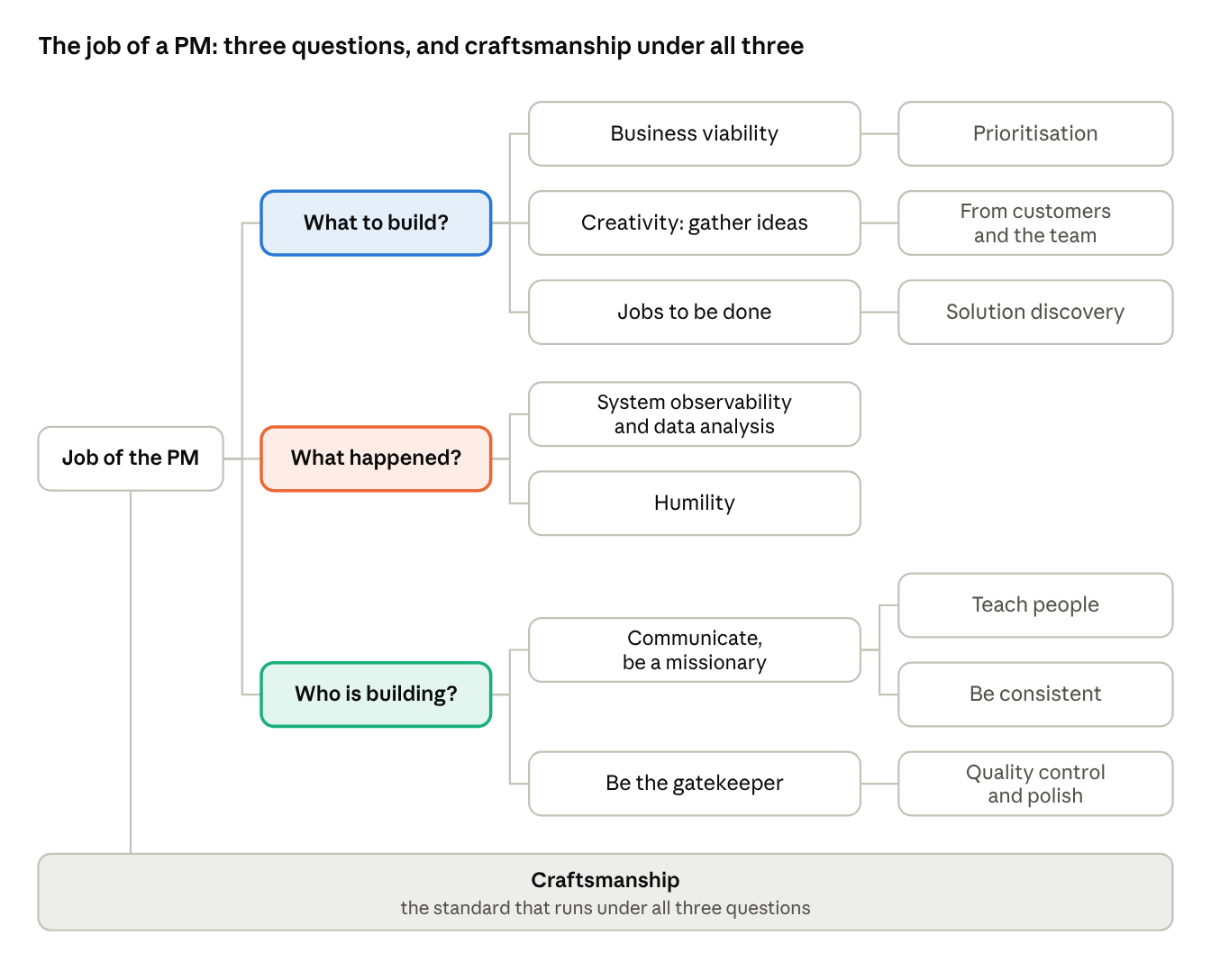
A product manager's job today comes down to three questions: what should we build, what happened after we shipped, and who is doing the work? The PM answers for a business result across all three, with craftsmanship as the standard.
Why the job needs restating
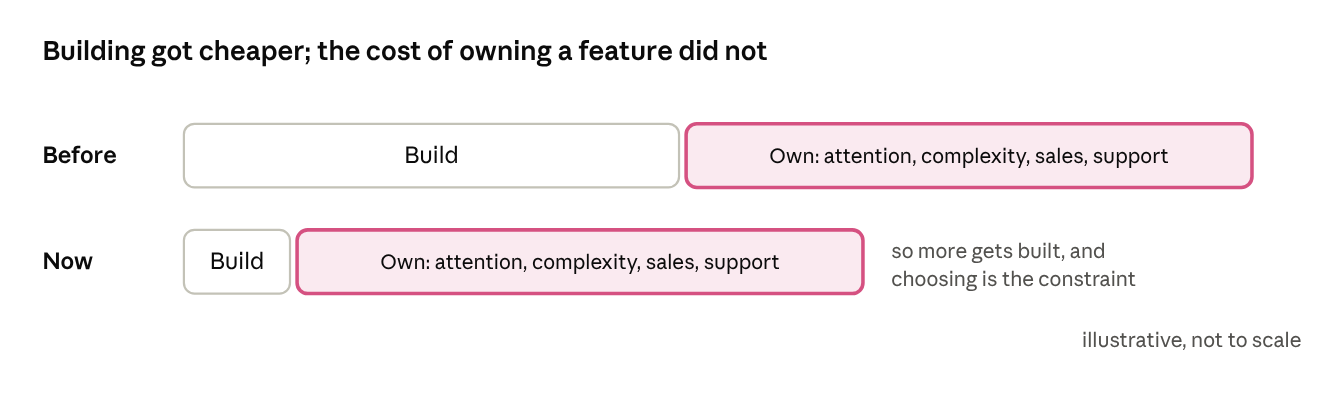
A small team with modern tools, including AI assistants, can prototype an idea in an afternoon. That makes it reasonable to ask what a product manager is still for.
Building has become cheaper, but ownership has not. Every feature that ships competes for customer attention, adds complexity to the product and may have to be sold and supported for years. As teams build more, neither customer attention nor the capacity of sales and support grows to match. The constraint is choosing what deserves to exist.
Someone has to make those choices and answer for the result. It could be a founder or an engineering lead. A dedicated PM earns their salary by improving the odds: backing more bets that pay off and ending weak ones sooner. They also take responsibility for a number the business cares about.
Many PMs answer for that number without controlling the roadmap or the release date. Where the call is theirs, so is the miss. Where it is not, they answer for the evidence and the recommendation they brought to whoever made it.
What to build?
Business viability and prioritisation
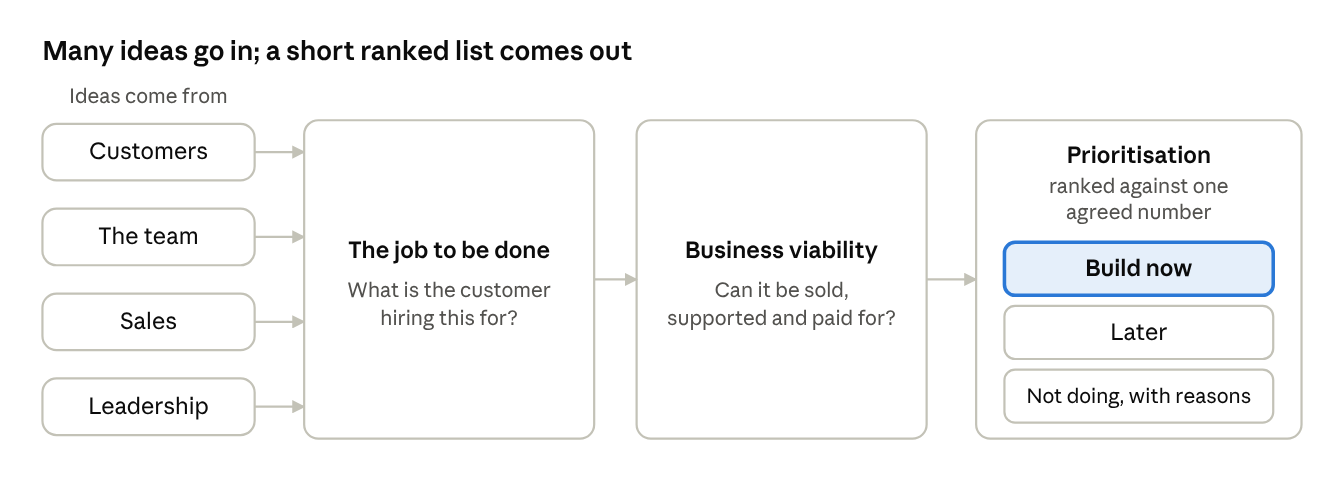
A feature customers love can still sink a company if it cannot be sold, supported or paid for. A ranked roadmap is a spending decision. It commits the team's salaries for weeks and the company's support capacity for years.
Strategy sets the outcome. The PM turns that outcome into a number the team can move this quarter, one that leads to retention or revenue, such as trial-to-paid conversion. They agree on the number and its target with their manager. For bets too big to resolve within a quarter, they agree on useful evidence along the way, such as a paid pilot.
The PM then ranks the bets most likely to move the number and writes down which good ideas the team will leave alone, along with the reasons. Without that second list, a roadmap can easily become a collection of additions rather than a set of choices.
If the ranking or the number is handed to you, be able to explain it, and bring evidence that tests it: a count of support tickets, the reasons deals were lost, what three customers said.
Where ideas come from
The best ideas rarely start with the PM. Customers know their problems. Engineers know what has just become possible. Support sees what breaks, while sales hears why deals are lost. The PM's creative work is to keep those channels open, connect what they hear and credit the people who brought the ideas.
Increasingly, those ideas arrive as working demos, which can be more persuasive than they deserve to be. A demo answers one question: can we build it? The PM still has to decide whether the result is worth owning and should judge every demo, including the founder's, by the problem it solves.
Jobs to be done and discovery
People hire a product to make progress on something. Clayton Christensen's commuters bought a milkshake to make a long drive less dull, so its rivals were bagels and doughnuts. To find the job, ask sales or support to put you on calls with recent buyers and recent leavers. Ask what those customers were trying to do when they switched.
Solution discovery is the continuing work of testing ways to do that job. A PM can now build the first prototype and should be as critical of it as they would be of anyone else's. If a bet is cheap and easy to undo, put it in front of a few customers and watch what they do. If it is costly or hard to reverse, interview and test prototypes before anyone builds the real thing.
What happened?
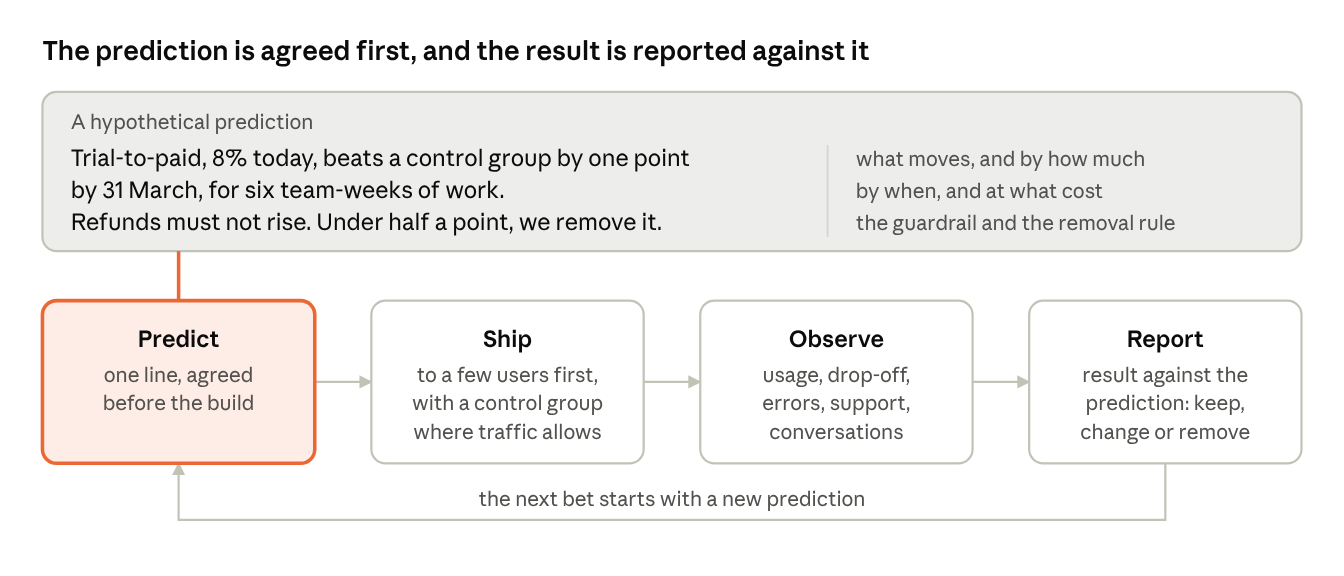
Shipping is the midpoint. The team still has to find out what happened and report it honestly.
Observability and data analysis
Before the build starts, write down the prediction in one line. Name the number that should move, the size and timing of the expected change, the cost, the guardrail and the result that would justify removing the feature. For example:
Trial-to-paid, 8% today, beats a control group by one point by 31 March, for six team-weeks of work. Refunds must not rise. Under half a point, we remove it.
If nothing measures the number yet, make the measurement part of the work.
After launch, check usage and the steps where people drop out. Look at errors, speed, support tickets and sales calls as well. A before-and-after comparison can be distorted by the season or another launch. If you have enough traffic, hold back a control group of randomly chosen users who do not get the change. If you do not, as in much B2B software, predict something the feature alone can move, such as its own completion rate. Add customer conversations and be honest that the final verdict is a judgement.
Humility
In a 2009 paper on experimentation at Microsoft, Ronny Kohavi and colleagues reported that only about a third of well-run experiments improved the metric they were meant to improve. Assume your ideas are no better. Conviction will not tell you which third you are holding.
A written prediction cannot be quietly revised. Without one, analysis becomes a hunt for numbers that flatter the launch. Compare the result with the prediction, then report it to whoever agreed on the number, along with a recommendation to keep, change or remove the feature. Removal has a price, but it also ends the ongoing cost of a feature that missed.
A missed bet is normal, and at those odds, so is a short run of them. Finding out late is the worrying part. Over two or three quarters, a PM should expect to be judged on whether the bets they backed moved the agreed number and how quickly and cheaply they found the misses.
You may not own the roadmap, but you own the prediction and the report. That record is how a PM earns a say in what gets built next.
Who is building?
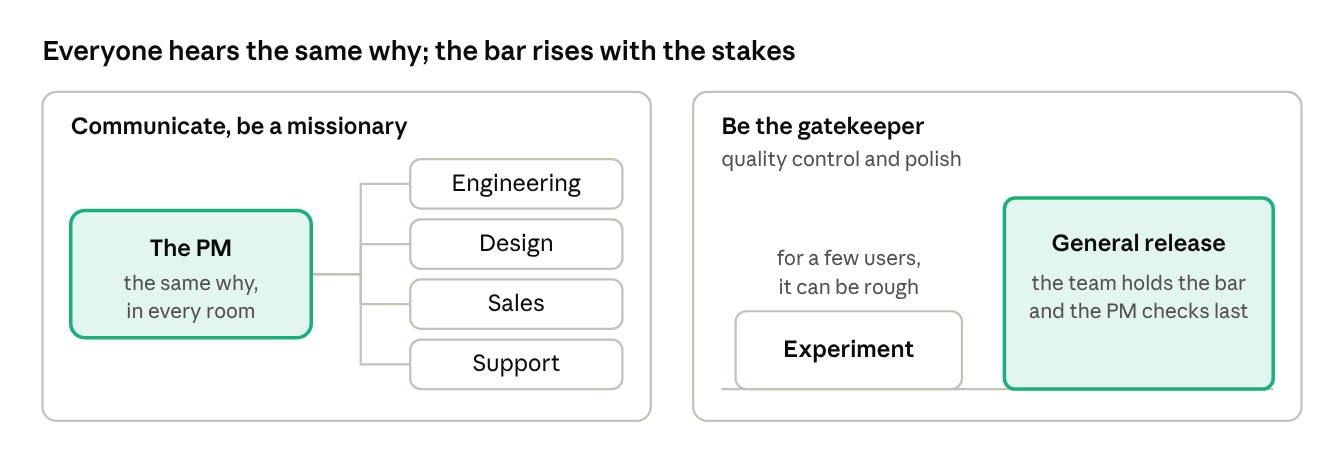
Communicate like a missionary
A PM ships nothing alone. Marty Cagan argues for teams of missionaries, who believe in the problem, rather than mercenaries, who build what they are told. People make many small decisions every week without you. They make them well only if they understand the customer and the goal.
- Teach what you know that others do not, which is usually the customer. Share the evidence with the conclusion. Bring engineers and designers to customer calls, walk through the numbers and make sure everyone can explain how the business makes money.
- Say the same thing in every room, every week, until you hear it repeated back. When the strategy changes, say so and explain why. Take your doubts and evidence to whoever set the direction. Tell the team what has been decided and what remains open.
Be the gatekeeper for quality and polish
A missionary team owns its own quality, and the PM is its last check before a general release. Use the product as a new customer would and note every hesitation, whether it is a blank first screen, a slow page or a confusing word.
Delay is as real a cost as a defect, so the bar rises with the stakes. An experiment shown to a few users can be rough; a general release cannot. Agree the bar with the team at the start so that everyone holds it. When something ships below the bar, give the fix an owner and a date.
Craftsmanship
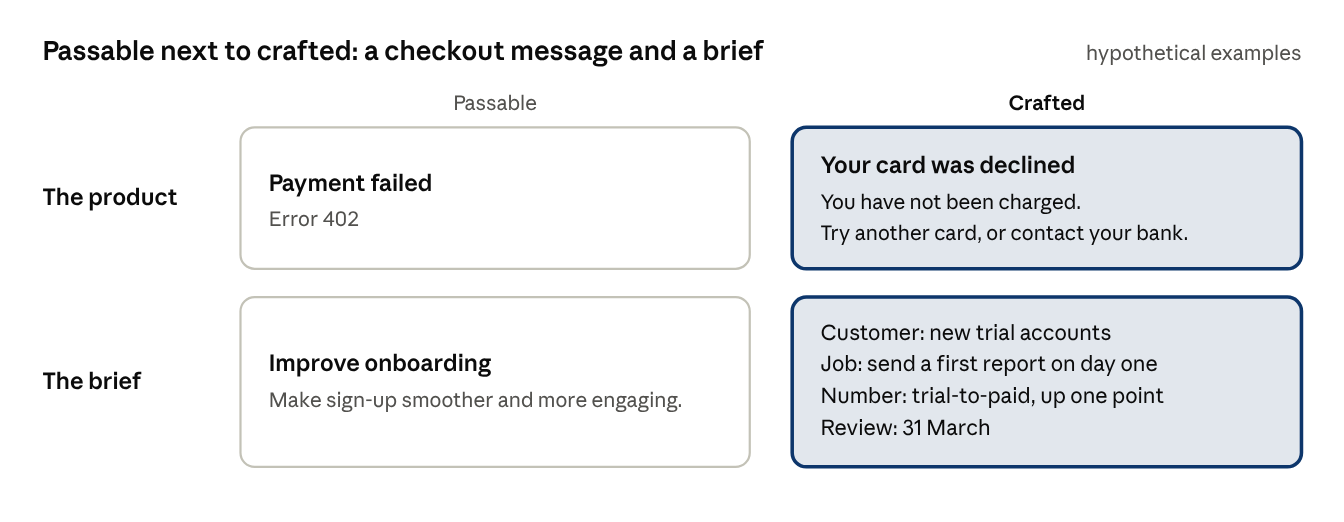
Craftsmanship means telling passable from good and caring enough to close the gap, both in the product and in your own work. In the product, it might be a checkout that explains why a card was declined. In the PM's work, it is a brief that names the customer, the job, the number and the review date.
Craft matters more as tools improve. AI can produce a passable spec, analysis or design in minutes, so more passable work arrives at the gate. A team may need fewer PMs. The ones it keeps will be able to spot the difference between passable and good, then spend the time they save with customers and inside the product.
You train that eye by studying the best products you use and rewriting your own work until a newcomer can act on it. Craft takes time, so spend it first where customers and money meet: sign-up, checkout and pricing.
The loop
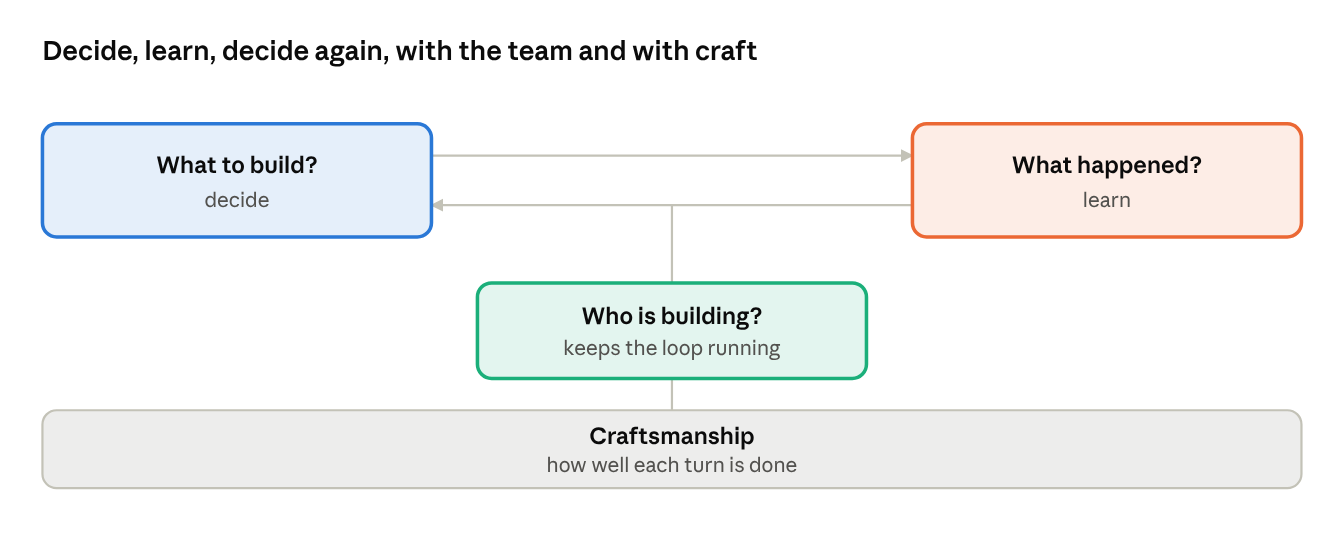
The first two questions repeat: decide, learn, then decide again. Answering the third keeps that cycle running when you are not in the room, and craft determines how well the team handles it.
A weekly test for any PM:
- Can I explain why our top priority is the top priority, which number it should move, and what we are not doing?
- Do I know whether the agreed number is moving, and how long our last miss ran before we caught it?
- Could everyone on the team say what we are building and why?
- Would I put my name on what we are about to release?
A "no" points to next week's work.
Sources
- Online Experimentation at Microsoft, Kohavi, Crook, Longbotham and others, 2009: the one-third finding.
- Clay Christensen's Milkshake Marketing, Carmen Nobel, HBS Working Knowledge, 2011.
- Missionaries vs. Mercenaries, Marty Cagan, SVPG, 2015, crediting John Doerr. Doerr's original distinction was about entrepreneurs: Knowledge at Wharton, 2000.